
Cetaceans in the Canary Islands
Discover the cetaceans of the Canary Islands
In the world there are about 90 species of cetaceans in a wide variety of shapes and sizes; from the smallest dolphins, which measure just over 1 meter in length, to blue whales which, at 30 meters long, are the largest living creatures on Earth.
In the Canary archipelago, 30 different species of cetaceans have been identified to date, some of them resident in different areas of the islands. This is largely due to its geographical location, the depth of its waters, ocean currents, and water temperature.
Considering that some cetacean species are found only in polar regions or in certain rivers, it is a privilege that we can enjoy one third of all species in our archipelago. Few places in the world offer such diversity.

Tursiops truncatus
Bottlenose Dolphin
The bottlenose dolphin, or common bottlenose dolphin, is the most common and well-known dolphin species, famous for its intelligence and sociability. It inhabits warm and temperate seas around the world. They swim at speeds of 5–11 km/h, breathing every 5–8 minutes. They live in social groups called pods, which can include up to 12 individuals.
On average, adults measure between 2 and 4 meters in length and weigh between 150 and 650 kg. They reproduce every 2–3 years, with a gestation period of 11–12 months. Females live up to 40 years, while males rarely exceed 30. Their diet is based on fish and invertebrates, and they use echolocation to find food.
The bottlenose dolphin is considered one of the most intelligent animals on the planet. This is demonstrated by its large brain, a language of clicks and whistles, self-recognition in mirrors, the ability to learn gestures, and the use of tools, suggesting a form of culture.


Delphinus delphis / capensis
Common Dolphin
The genus Delphinus includes two main species: the long-beaked common dolphin (Delphinus capensis) and the short-beaked common dolphin (Delphinus delphis). They are highly social animals that usually travel in groups of ten to fifty individuals, although they can come together to form large aggregations of up to 2,000 animals.
It is one of the most recognizable species, famous for its hourglass-shaped color pattern on its sides. Adults typically measure between 1.7 and 2.4 meters and weigh between 70 and 135 kg. The gestation period is approximately eleven months, and they reach sexual maturity at around five years of age. They can live up to twenty-five years.
Pseudorca crassidens
False Killer Whale
Despite its name, the false killer whale is not as closely related to the killer whale as it might suggest. It is one of the largest members of the oceanic dolphin family (Delphinidae). It has a long, slender body, uniformly dark gray to black in color, with a small, rounded head and no distinct beak.
Males can reach up to 6 meters in length and weigh up to 2.2 tons. They are highly social animals, forming tight-knit groups of 10 to 50 individuals. Their diet consists mainly of large fish and cephalopods. They are active and fast swimmers, known for leaping out of the water and approaching boats to ride their bow waves.
Gestation lasts between 14 and 16 months, and calves are nursed for up to two years. Females usually have a calf only once every 6–7 years. They are one of the species most frequently involved in mass strandings.


Globicephala macrorhynchus
Pilot Whale
Also known as the short-finned pilot whale, it is a cetacean of the Delphinidae family. It is a species commonly sighted in warm and tropical waters. It has a robust, cylindrical body, black or very dark gray in color, with a bulbous, rounded head and no distinct beak.
Males can reach up to 7.2 meters in length and weigh up to 3,600 kg. They are very common in the Canary Islands, where they can be observed year-round, making them one of the region’s emblematic species. Their diet consists mainly of squid and octopuses.
They are highly social, living in stable groups with strong family structures. Males live up to approximately 45 years, and females can live up to 60 years. They are active at the surface, performing leaps, spyhopping, and approaching boats.
Grampus griseus
The Risso‘s Dolphin
Also known as Risso’s dolphin, it is one of the most distinctive cetacean species. It is born with a dark gray coloration, but as it ages its body becomes covered with elongated white scars, resulting from interactions with other individuals and from the suction cups of the squid it feeds on. Some older individuals may appear almost white from a distance.
Adults reach between 3.2 and 4.3 meters in length and weigh between 350 and 500 kg. They have a robust, bulbous head with a distinctive vertical crease on the forehead. Their diet consists almost exclusively of cephalopods, mainly squid. In the Canary Islands, it is a species that can be observed, although it is less common than the short-finned pilot whale.


Stenella attenuata / frontalis
Spotted Dolphin
The term “spotted dolphin” includes the pantropical spotted dolphin (Stenella attenuata) and the Atlantic spotted dolphin (Stenella frontalis). Juveniles are born light gray, and as they mature they develop characteristic spots that vary with age. They are medium-sized dolphins, measuring between 1.7 and 2.4 meters and weighing 90–115 kg.
They are extremely social and form groups of highly variable size, from just a few individuals to several thousand. They are known for their active and playful behavior: they frequently engage in bow-riding, perform acrobatic leaps, and may mix with other dolphin species and even with schools of tuna.
Steno bredanensis
Rough-toothed Dolphin
Its name refers to the presence of ridges or vertical wrinkles on the surface of its teeth. It has a long, conical head with no clear demarcation between the melon and the snout, giving it a different appearance from the typical “beak” of other dolphins. They are medium-sized dolphins, measuring between 2.1 and 2.8 meters and weighing 100–160 kg.
They are found in tropical and subtropical waters of all oceans. In the Canary Islands, where the continental shelf is narrow, they can be observed close to the coast. They feed mainly on fish and cephalopods and are excellent divers, capable of dives lasting up to 15 minutes. They live in groups of 10 to 30 individuals and often associate with pilot whales and false killer whales.

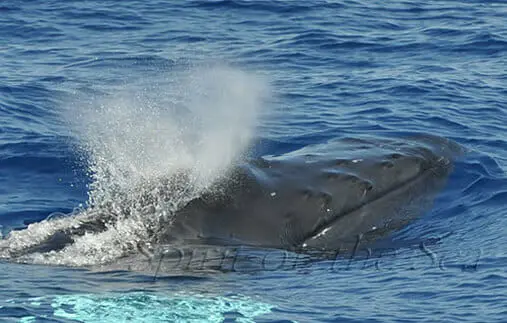
Megaptera novaeangliae
Humpback Whale
Also known as the humpback whale, it is one of the most emblematic and recognizable species, famous for its aerial acrobatics and complex songs. Males measure on average 15 meters and females up to 19 meters, with a weight of 30 to 48 tons. One of its most distinctive features is its extremely long pectoral fins, which can reach up to one third of its body length.
They undertake one of the longest migrations of all mammals, traveling up to 8,000 km. They are famous for their cooperative hunting technique called “bubble net feeding” and for the long and complex underwater songs of males, which can last between 10 and 20 minutes. The coloration pattern of the tail fin is unique to each individual, like a fingerprint.
Stenella coeruleoalba
Striped Dolphin
It is one of the most abundant and widespread dolphin species in the world. They are medium-sized dolphins, measuring between 1.8 and 2.5 meters in length and weighing 100 to 160 kg. Their most distinctive feature is the “stripes” or dark lines running along their flanks: one or two dark blue bands extending from the eye to the tail fin, and other stripes from the ears to the pectoral fins.
They live in cohesive groups of up to several hundred individuals. They are very active and playful, performing leaps, chin slaps, and aerial spins. They are known for being the most abundant cetacean in the Mediterranean. The estimated global population exceeds two million individuals. They reach sexual maturity between 6 and 13 years of age and can live for more than 25 years.


Balaenoptera edeni
Bryde’s Whale
Also known as Bryde’s whale, it is one of the smallest rorquals, with a length that rarely exceeds 16 meters and a weight of up to 26 tons. One of its distinctive features is the three parallel longitudinal ridges on the top of its head, which distinguish it from the sei whale (which has only one). In the Canary Islands, it is one of the baleen whales that appears regularly.
It inhabits warm and subtropical waters around the world with temperatures of at least 20°C. They are generally seen alone or in pairs, although in areas with abundant food they may form groups of up to 20 individuals. They feed on pelagic fish, squid, and crustaceans, and have been observed encircling schools at high speed to compress them before engulfing them. Females usually give birth to one calf every two years.

