
Tropical Calderon
Sighting
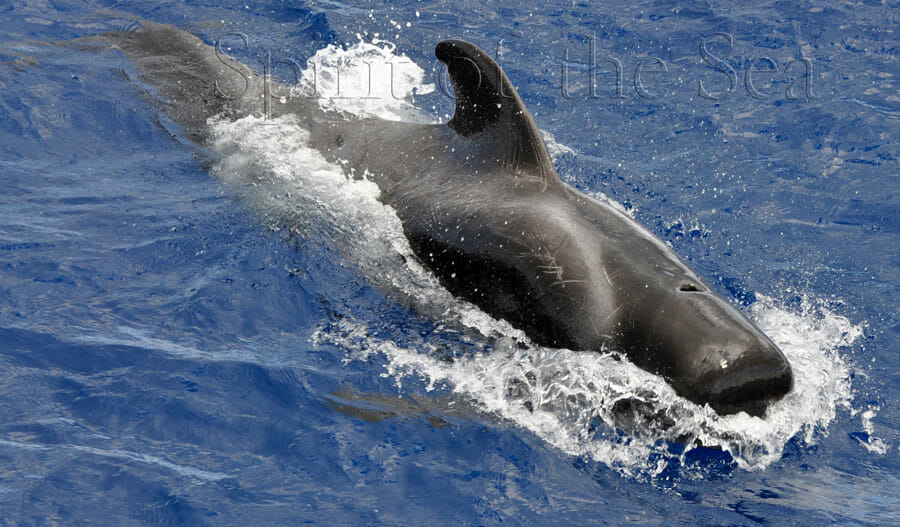
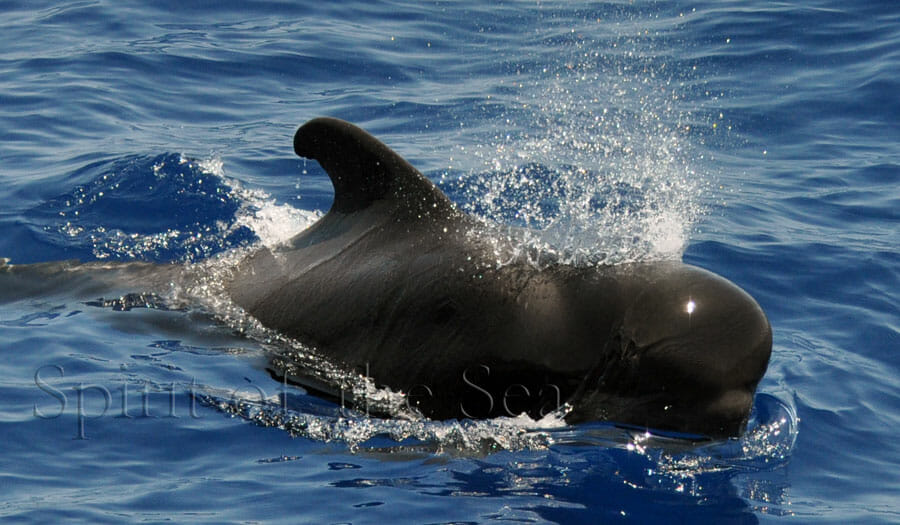
Tropical Pilot Whale in Gran Canaria (Globicephala machrorynchus)
The tropical pilot whale in Gran Canaria is one of the most common species to be seen on every sighting, as this species generally inhabits warm, tropical and deep waters.
This species belongs to the oceanic dolphin family, despite resembling a whale.
Physical characteristics of the Tropical Pilot Whale
One of the most notable physical characteristics of the tropical pilot whale is that males are larger than females, reaching up to 7.2 metres in length and weighing up to 3,600 kg. Another characteristic is that males live to approximately 45 years of age, while females have a longer lifespan, living up to 60 years.
This species has a robust, cylindrical body that is black or dark grey in colour with a characteristic lighter-coloured ‘saddle’ mark behind the dorsal fin and an anchor- or ‘V’-shaped ventral mark. It also has a bulbous, round head (without a defined beak) and a large, broad, curved dorsal fin. It should be noted that they are expert divers in very deep waters and skilled at hunting their prey, which is why their diet consists mainly of squid and octopus, although they may also consume fish.
Intelligence and social behaviour
The Tropical Pilot Whale is a species that communicates through a variety of vocalisations, including clicks, whistles, and pulses. They are also highly social, living in stable groups and pods that vary in size. Within these groups, there is a strong family structure and cooperative behaviour is observed. They are active animals on the water’s surface, often jumping, spying, and approaching our boats.
It is undoubtedly a fascinating species and an important indicator of the health of deep-sea marine ecosystems.
Frequently asked questions about whale watching
Are sightings guaranteed?
We operate in a natural environment, so we cannot guarantee sightings. Gran Canaria offers frequent encounters with dolphins and whales, and our crew uses their experience and knowledge to maximise the chances of observing different cetaceans.
When is the best time of year to see tropical pilot whales in Gran Canaria?
Pilot whales and other cetaceans can be seen throughout the year in Gran Canaria. Calmer sea conditions tend to improve comfort and visibility, so many guests prefer to enjoy the experience from late spring to early autumn.
From which port do the excursions depart?
All our excursions depart from our home port, located in Puerto Rico (Gran Canaria). It is the marina on the left when facing the sea. We offer a hotel pick-up service on request from Mogán to Playa del Cura and from Bahía Feliz to Meloneras (please enquire when booking).
How long does the experience last?
Our whale watching excursion lasts 2.5 hours. We usually depart twice a day, at 10:30 and 13:30. The 13:30 departure may include a short stop for swimming if conditions permit, so bring your swimsuit and towel.
Is it suitable for children? Any advice for seasickness?
Yes, families are welcome. If you are prone to seasickness, consider taking preventive medication before boarding and try to limit your movements on the boat, as well as staying in open, well-ventilated areas. Our crew is trained to help.

