
Rough-toothed dolphin
Sighting
Rough-Toothed Dolphin (Steno bredanensis)
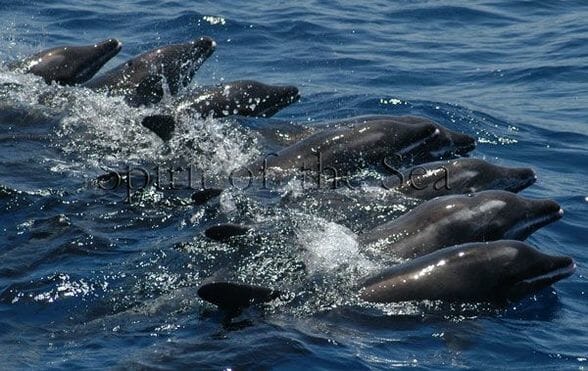
The rough-toothed dolphin (Steno bredanensis) is one of the most distinctive cetacean species found in the waters around Gran Canaria. Recognisable by its unique conical head and the smooth profile from melon to beak with no visible crease separating the two this dolphin has an almost primitive, reptilian appearance that sets it apart from other species in the area.
The species gets its common name from the fine vertical ridges that cover its teeth, a feature unique among dolphins, although these ridges are not visible on live animals at sea. Despite this, the rough-toothed dolphin can be identified during whale watching excursions by its characteristic silhouette and distinctive swimming behaviour.
How to Identify a Rough-Toothed Dolphin
From a distance, the rough-toothed dolphin can be mistaken for the bottlenose dolphin, which is also frequently seen in the waters around Gran Canaria. However, there are several features that allow it to be identified during a sighting:
- Head shape: a smooth, sloping profile from the forehead to the tip of the snout, with no crease between the melon and the face.
- Lips: Distinctively white or pinkish colouration on the lower jaw and lips.
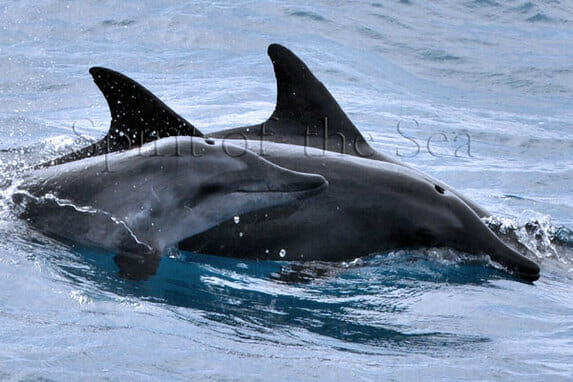
- Dorsal fin: Tall and slightly upright, situated in the centre of the back, with relatively large pectoral fins situated further back along the body.
- Body markings: Dark grey on the back with lighter flanks, often marked with irregular white or pink spots and speckles on the ventral and lateral areas. Older individuals often have circular scars caused by bull shark bites.
- Swimming style: Rough-toothed dolphins typically swim in compact, synchronised subgroups, a behaviour sometimes described as swimming ‘in formation’. It is also common for them to glide across the surface with their head and chin above the water.
Behaviour and Social Structure
Rough-toothed dolphins are typically found in small, tight-knit groups of 10 to 20 individuals, although gatherings of up to 100 have been recorded. These larger groups are thought to be temporary assemblages made up of smaller, more stable family units of two to eight closely related animals.
This species is considered one of the most intelligent dolphin species, with notably large brains relative to body size. They are highly sociable and are frequently observed associating with other cetacean species, including bottlenose dolphins, short-finned pilot whales and spotted dolphins.
Rough-toothed dolphins are capable of diving to depths of at least 50 metres and can remain submerged for up to 15 minutes. Their diet consists mainly of fish including larger species such as mahi-mahi as well as squid and octopus.
Where to See Rough-Toothed Dolphins in Gran Canaria
The rough-toothed dolphin is a resident species in the Canary Islands, present year-round in the deep waters surrounding the archipelago. Scientific research off the neighbouring island of La Gomera confirmed year-round presence, with 145 sightings recorded over a five-year period. The species shows a preference for the surroundings of steep volcanic islands where deep waters reach close to the coast exactly the conditions found off the south and southwest coast of Gran Canaria.
On our whale watching tours from Puerto Rico de Gran Canaria, rough-toothed dolphins are among the cetacean species that can be encountered, particularly in waters beyond 500 metres depth at relatively short distances from the coast. While sightings are less frequent than for bottlenose dolphins, encountering a group of rough-toothed dolphins swimming in their characteristic tight formation is a memorable experience.
All our excursions depart from Puerto Rico marina (the marina on the left when facing the sea). Our whale watching tour lasts 2.5 hours, with daily departures at 10:30 and 13:30. The afternoon departure may include a short swimming stop if conditions allow.
We offer a hotel pick-up service on request from Mogán to Playa del Cura and from Bahía Feliz to Meloneras (please enquire when booking).
Conservation Status
The rough-toothed dolphin is classified as Least Concern on the IUCN Red List, although the global population is not well documented. The main threats to the species worldwide include entanglement in commercial fishing gear, particularly longline and gillnet fisheries, as well as noise pollution that disrupts their echolocation and communication.
In the Canary Islands, cetaceans benefit from marine protection regulations. The waters around Gran Canaria are recognised as one of the most diverse areas for cetacean species in Europe, with approximately 30 species recorded across the archipelago.
The species is protected under several international agreements, including ACCOBAMS (Agreement on the Conservation of Cetaceans in the Black Sea, Mediterranean Sea and Contiguous Atlantic Area) and the Western African Aquatic Mammals MoU.
Frequently Asked Questions About the Rough-Toothed Dolphin
Can you see rough-toothed dolphins in Gran Canaria?
Yes. The rough-toothed dolphin is a resident species in the Canary Islands and can be seen year-round in the deep waters off the coast of Gran Canaria. While sightings are less predictable than for bottlenose dolphins, they are regularly encountered during whale watching excursions, especially in deeper waters south and southwest of the island.
How is the rough-toothed dolphin different from the bottlenose dolphin?
The most visible difference is the head shape. The rough-toothed dolphin has a smooth, sloping profile from the forehead to the beak with no crease, while the bottlenose dolphin has a clearly defined melon and shorter beak. Other differences include the rough-toothed dolphin’s white lips, taller dorsal fin and tendency to swim in tight synchronised subgroups.
How big are rough-toothed dolphins?
Adults typically reach between 2.09 and 2.83 metres in length and weigh between 90 and 155 kg. Males are generally larger than females.
What do rough-toothed dolphins eat?
Their diet consists of fish (including larger species such as mahi-mahi), squid and octopus. They are capable of deep dives to find their prey.
Where do Spirit of the Sea excursions depart from?
All excursions depart from Puerto Rico marina in Gran Canaria. We offer a hotel pick-up service from Mogán to Playa del Cura and from Bahía Feliz to Meloneras.

